




AdBlue Automation · Software First

Manage AdBlue with software —
whatever brand the hardware is

ELPO is a software company. At the core of our AdBlue solution is not hardware but the automation software that manages every tank and dispensing unit on site from a single screen. The unit may be an IBC cabin or a different-brand dispenser — our software talks to all of them.
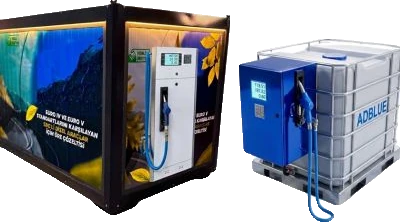
AdBlue dispensing unit / IBC cabin
Software First

You buy the hardware; the real value comes from software

An AdBlue tank and dispensing unit on its own is just a store. What turns it into an operation — measuring the level, counting each refill, recording every sale, planning delivery for tanks running low and gathering it all on one panel — is ELPO software.

Real-time tank level monitoring

Level, temperature and refill history of the AdBlue tank stream to the center 24/7. Tanks dropping to a critical level trigger automatic alerts.

Refill and sales logging

Every AdBlue refill is logged by measure; stock is compared against sales in real time, preventing loss and manipulation.

Plan delivery ahead

Because low tanks are seen in advance, the delivery tanker never sets out empty-handed; routes are planned from fill-level forecasts.

Vendor-Independent

Our software talks to every pump

You do not need to replace your equipment on site. ELPO AdBlue software speaks to your existing pumps, dispensers, meters and tank probes over standard industrial protocols, regardless of brand; it also communicates with new-generation fuel-pump fiscal payment terminals. Whatever hardware you already have, our software sits on top of it.

RS485 / Modbus RTU · TCP
Pulse and 4-20 mA current loop
OPC UA and third-party ATG probes
Domestic, imported and mixed-brand dispensers
Pump not on the list → we add it to the system very fast
NO new hardware required
No vendor lock-in

Rival solutions usually force their own hardware on you; you cannot step outside their brand. Because ELPO is a software house, it does the opposite: it connects to any pump/tank and gathers them on one panel. We build hardware too (the RK3568 field board) but it is not mandatory — the choice is yours.

AX Automation ecosystem
Multi-Tenant Central Monitoring

Not at the tank — from one screen the whole AdBlue network

The same data is viewed through three different lenses by permission: the producer's dispensing network, the distributor's station chain, the owner's own stations — all on one panel.

AdBlue Producer
All dispensing points

Monitors from the center which station and tank its AdBlue is in and how much is left. Plans delivery ahead for tanks running out.

Fuel Distributor
Contracted station network

If the producer partners with a fuel distribution company, the distributor sees the AdBlue status of every station in its network on one panel.

Station Owner
Their own stations

An owner with several stations monitors the tank level, refills and sales of all of them on one screen, without connecting to each station separately.

The central management behind these three views is a product of its own: CX Central

ELPO
License No: 2024/AKR-4471 · Central Station
Tank Monitoring — AdBlue
Service running
AdBlue
Tank #1
%84
22°
16.840 / 20.000 L
Normal
AdBlue
Tank #2
%81
21°
8.120 / 10.000 L
Refilling
AdBlue
Tank #3
%18
23°
2.160 / 12.000 L
Critical level
AdBlue
Tank #4
%66
20°
9.900 / 15.000 L
Normal

Tank Monitoring screen — tank no, product, live volume/capacity, fill level, temperature and refill/fault status. At a critical level the system generates an automatic delivery alert. Values are illustrative.

Optional Hardware

If you wish, we build the field board and the unit too

The software works with any hardware; but for those who want a complete single-source solution, ELPO also offers its own field board and AdBlue unit.

Our own board

ELPO Edge — RK3568 Field Board

The edge unit that collects level/temperature data from the AdBlue tank and meter data from the dispensing unit and carries it to the center is our own RK3568-based electronic board, designed by ELPO engineers.

  • Rockchip RK3568 · 4× Cortex-A55 @ 1.99 GHz
  • Mali-G52 GPU + 0.8 TOPS NPU (AI accelerator)
  • 4 / 8 GB LPDDR4 · eMMC + microSD + NVMe
  • Gigabit Ethernet · RS485 / probe inputs · GPIO
  • RTC + backup battery, clock/data preserved on power loss
  • Industrial, low power consumption (~4W)
AdBlue Cabin / IBC dispensing unit
AdBlue Dispensing Unit
Field unit — connects to ELPO software regardless of brand. On request we supply the unit too.
Not just stations Fuel station Construction site Fleet and logistics depots Agriculture and mining Heavy industry facilities
Frequently Asked Questions
What is AdBlue automation (AdBlue dispensing facility automation)?
AdBlue automation is software that monitors and manages AdBlue tanks and dispensing points from the center. It tracks tank level, temperature and refill history 24/7; logs refills and sales by measure and plans delivery ahead for tanks running out. It communicates with field pumps and dispensers vendor-independently.
What is multi-tenant (producer → distributor → station) monitoring?
The AdBlue producer monitors all dispensing points, the fuel distributor its contracted station network, and the station owner its own stations from a single panel. Each role sees the tank level, refills and sales within its own scope.
Is it vendor-independent, does it work with all pumps?
Yes. It works with your existing field pumps, dispensers and meters regardless of brand (RS485/Modbus, pulse, 4-20 mA). Hardware not on the list is added to the system quickly; it is also supported by our own RK3568-based field board.
How is AdBlue replenishment planned, and when does the tanker leave?
CX Central monitors the tank level at every station and lists the ones that need replenishment. The route starts from the nearest production site or supply depot, the stops are put in order, and distance is computed over the real road network rather than as the crow flies. In the mobile app the driver sees the day's list with the stop order, litres and a critical badge; entering the litres delivered per tank creates the refill document automatically and the requirement drops from the central dashboard immediately. The tanker does not leave half empty, and an empty station is not skipped.
How are AdBlue losses and stock differences detected?
Litres sold are continuously compared with the level in the tank. The gap between expected consumption and the measured level is reported as loss or shrinkage, with temperature correction taken into account. The calculation runs in the application with traceable formulas — AI does not produce that number, it only interprets the deviation and writes the reasoning. If an operator is going to dispatch a tanker on the strength of a number, where that number came from has to be visible.
How is payment collected, and which methods are supported?
The unit can run on tokens, cards or contactless payment and connects to the station's existing payment infrastructure. At the moment of sale, which unit, which product and how many litres are recorded and appear on the central dashboard. Sales and payment are reconciled in a separate audit step, and any difference is reported.
How many tiers are supported — producer, distributor, station?
All three are defined separately in the same system and each tier sees only its own data. The producer follows production and dispatch, the distributor the stations in its region, the station its own tank. Revenue sharing is calculated from the contract, and the entitlement is reported as accrued, paid and unpaid.
What does AdBlue automation actually do for me?
It monitors the level and the sales of your AdBlue tanks in the field from one place. Because you see in advance when a tank will run dry, the delivery tanker never leaves on a wasted trip; the route is planned from the projected fill levels. The real gain is not in the hardware, it is in the software doing that planning.
Does it work with my existing dispensers and tank gauges?
In most cases yes: pulse and 4-20 mA current-loop outputs, OPC UA and third-party ATG probes are supported, and it runs with domestic, imported and mixed-brand dispensers. Support for a pump that is not yet on the list is added quickly.
Does ELPO supply the field hardware as well?
Optional. The field board and the unit can be produced by ELPO; the unit runs on a board with a Rockchip RK3568 processor (4× Cortex-A55) and an AI accelerator. If you prefer to source the hardware yourself, the software connects to your existing equipment.
What do I need to set up an AdBlue refilling station?
An AdBlue tank (an IBC cabin or a fixed tank), a pump/dispenser with a meter that delivers measured volumes into the vehicle, token, card or contactless payment, and a probe that measures the tank level. What turns these into a business is the software: it tracks the level, records every refill in litres, compares sales with stock and plans replenishment before a tank runs dry. It can be installed at a fuel station, a construction site, a fleet depot or an agricultural or industrial site; whatever the brand of your existing pump, ELPO software connects to it.
What does an AdBlue pump do?
An AdBlue pump (dispenser) transfers AdBlue from the tank into the vehicle's AdBlue tank in measured volumes; its meter counts the litres delivered. For the station, the real value is turning those litres into records: ELPO software reads every refill from the pump's pulse or 4-20 mA output, posts it to sales and stock, and compares it with the tank level to report any difference.
What does the "AdBlue refill required" warning in a vehicle mean?
On diesel vehicles with an SCR exhaust system, this warning means the AdBlue tank is running low. If it is ignored, most vehicles will not allow the engine to restart until the tank is refilled; the threshold and behaviour depend on the manufacturer, so check the owner's manual. Refilling is done at a station with an AdBlue pump or from a canister. For a station operator it means the AdBlue tank must never run empty; ELPO software flags a tank reaching a critical level in advance.
White-Label · Partnership

ELPO works like your own software house

You do what you know best — sales, technical work, production, whatever your field is. We do what we know best: software. You market ELPO products under your own brand; ELPO handles development, updates and regulatory compliance in the background, just like your own team. Launch your own software brand without writing code or building a team — let's win together.

Your brand, your domain

ELPO products as if it were your own product — your logo, your colors, your domain. Your customer sees you, not the ELPO behind it.

You run your own business

Sales, technical support, production — stay in your field. We handle the software, the thing we know best; everyone on their strong side.

ELPO owns the development

ELPO builds the product, updates it and keeps it compliant with regulations — just like your own back-office software team.

Source-code sharing when needed

If needed, we also share source code depending on the agreement. The product truly becomes yours; your future isn't tied to a single vendor.

Become a partner / reseller White-Label and Source Code — details Let's talk about revenue-share, dealership, solution partnership, OEM and — subject to agreement — source-code sharing models.

Manage your AdBlue network from one screen

Whatever brand your existing pump is — ELPO software connects, monitors and reports.