How is AdBlue replenishment planned, and when does the tanker leave?
CX Central monitors the tank level at every station and lists the ones that need replenishment. The route starts from the nearest production site or supply depot, the stops are put in order, and distance is computed over the real road network rather than as the crow flies. In the mobile app the driver sees the day's list with the stop order, litres and a critical badge; entering the litres delivered per tank creates the refill document automatically and the requirement drops from the central dashboard immediately. The tanker does not leave half empty, and an empty station is not skipped.
How are AdBlue losses and stock differences detected?
Litres sold are continuously compared with the level in the tank. The gap between expected consumption and the measured level is reported as loss or shrinkage, with temperature correction taken into account. The calculation runs in the application with traceable formulas — AI does not produce that number, it only interprets the deviation and writes the reasoning. If an operator is going to dispatch a tanker on the strength of a number, where that number came from has to be visible.
How is payment collected, and which methods are supported?
The unit can run on tokens, cards or contactless payment and connects to the station's existing payment infrastructure. At the moment of sale, which unit, which product and how many litres are recorded and appear on the central dashboard. Sales and payment are reconciled in a separate audit step, and any difference is reported.
How many tiers are supported — producer, distributor, station?
All three are defined separately in the same system and each tier sees only its own data. The producer follows production and dispatch, the distributor the stations in its region, the station its own tank. Revenue sharing is calculated from the contract, and the entitlement is reported as accrued, paid and unpaid.
What does AdBlue automation actually do for me?
It monitors the level and the sales of your AdBlue tanks in the field from one place. Because you see in advance when a tank will run dry, the delivery tanker never leaves on a wasted trip; the route is planned from the projected fill levels. The real gain is not in the hardware, it is in the software doing that planning.
Does it work with my existing dispensers and tank gauges?
In most cases yes: pulse and 4-20 mA current-loop outputs, OPC UA and third-party ATG probes are supported, and it runs with domestic, imported and mixed-brand dispensers. Support for a pump that is not yet on the list is added quickly.
Does ELPO supply the field hardware as well?
Optional. The field board and the unit can be produced by ELPO; the unit runs on a board with a Rockchip RK3568 processor (4× Cortex-A55) and an AI accelerator. If you prefer to source the hardware yourself, the software connects to your existing equipment.
What do I need to set up an AdBlue refilling station?
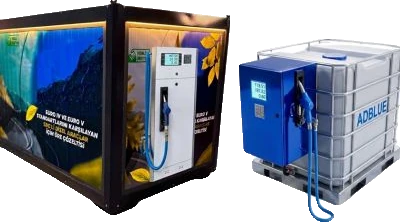
An AdBlue tank (an IBC cabin or a fixed tank), a pump/dispenser with a meter that delivers measured volumes into the vehicle, token, card or contactless payment, and a probe that measures the tank level. What turns these into a business is the software: it tracks the level, records every refill in litres, compares sales with stock and plans replenishment before a tank runs dry. It can be installed at a fuel station, a construction site, a fleet depot or an agricultural or industrial site; whatever the brand of your existing pump, ELPO software connects to it.
What does an AdBlue pump do?
An AdBlue pump (dispenser) transfers AdBlue from the tank into the vehicle's AdBlue tank in measured volumes; its meter counts the litres delivered. For the station, the real value is turning those litres into records: ELPO software reads every refill from the pump's pulse or 4-20 mA output, posts it to sales and stock, and compares it with the tank level to report any difference.
What does the "AdBlue refill required" warning in a vehicle mean?
On diesel vehicles with an SCR exhaust system, this warning means the AdBlue tank is running low. If it is ignored, most vehicles will not allow the engine to restart until the tank is refilled; the threshold and behaviour depend on the manufacturer, so check the owner's manual. Refilling is done at a station with an AdBlue pump or from a canister. For a station operator it means the AdBlue tank must never run empty; ELPO software flags a tank reaching a critical level in advance.










 PX · Pump Automation
 TX · Tank Automation
 ETOS · Tanker Automation
 CX · Central Station Management
 TTX · Vehicle Identification
 MTX · Customer Tracking