











What Is an AI-Native ERP? SmartERP vs Classic ERP
In traditional ERPs, AI is a feature added later. In an AI-native ERP, the platform is designed with AI from the ground up.
The Limits of Classic ERPs
Classic ERP solutions, which dominated the market for years, have treated artificial intelligence as a module added afterwards. First the transaction engine is built, then the UI is written on top of it, and AI is attached last as an extra feature. The result: a thin bridge between AI and the data, and a complex structure that often requires a dedicated integration team.
If you want to see side by side what each ERP offers: ERP software comparison — in the same table as Logo, Mikro, SAP and Odoo.
This architecture creates two problems. First, AI's access to real-time data is slow and full of friction. Second, adding a new module or changing a business process requires a developer — which means project cycles lasting weeks, consulting fees and constant technical debt.
The AI-Native Approach
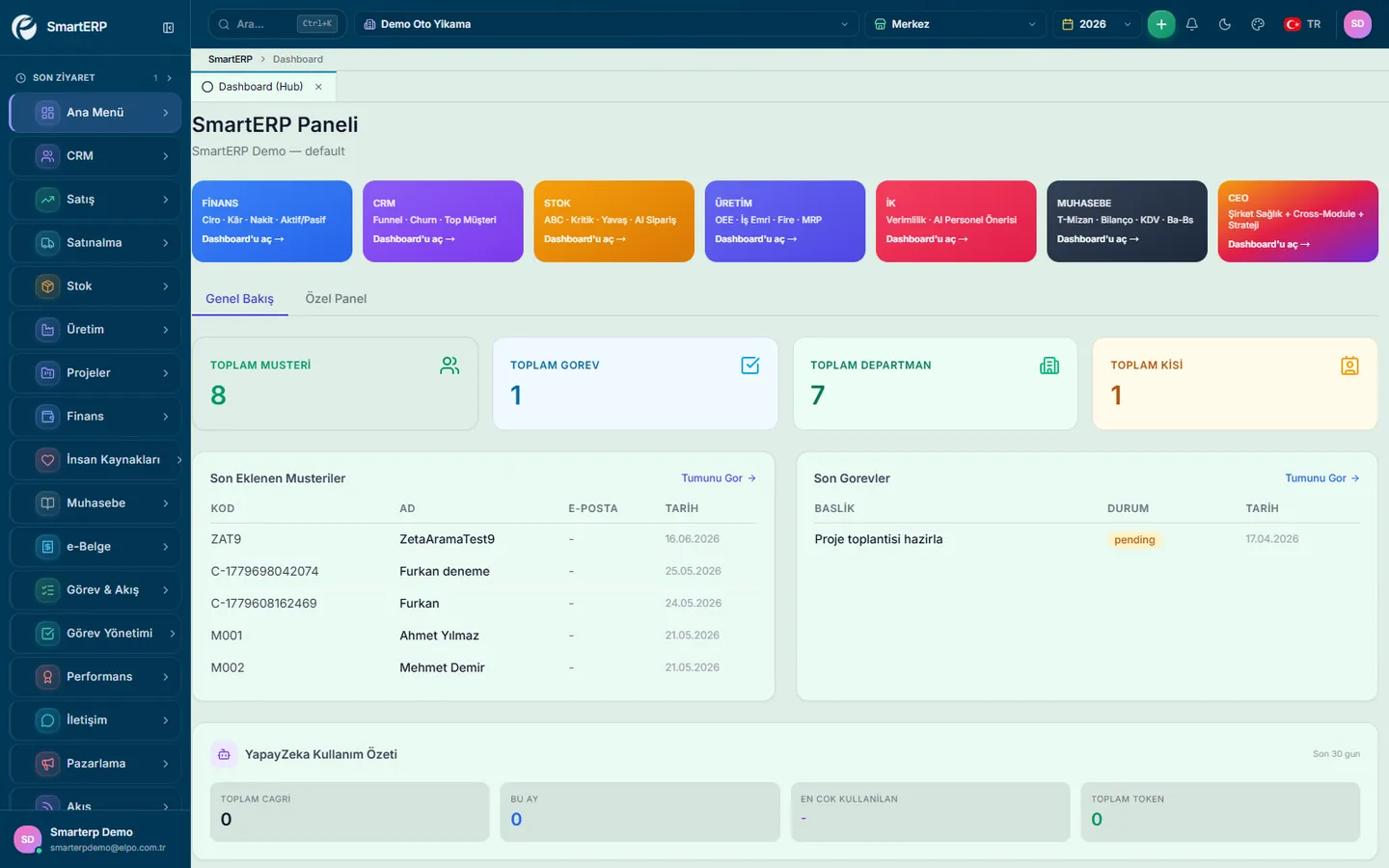
SmartERP is an AI-native ERP built from scratch on the ElpoCore platform. Here AI has not been attached afterwards; it is part of the platform's core architecture. All modules — accounting, customer and supplier accounts, stock, production, purchasing, HR, payroll — sit on the same metadata engine. The result: when a user says in plain Turkish "Create a module for this new business process, include these fields, give these people access", the system writes it as metadata and generates the UI/DB/API within minutes.
More Than 150 AI Agents
More than 150 AI agents are defined across SmartERP and the ElpoCore platform — Cash Application AI, Bank Reconciliation AI, Fraud Detection, Contract Intelligence, Proactive Anomaly Monitoring, Voice Command, Document Q&A, Demand Forecast, Compliance Watcher, RFM Cohort segmentation, Automatic Journal Entries, Month-End Close, Payment Prioritizer… These agents produce reports, offer decision recommendations and start actions.
Industry Packs in Development
Industry packs for SmartERP (food, furniture, textiles, automotive, healthcare, logistics, education, construction and others) are in development; core record types are defined, business rules and tests are not finished yet. No industry pack is ready today. When the packs are finished, a new company will pick its industry at setup and get that industry's record types and form templates.
Open Banking and 35 Banks
SmartERP is directly integrated with 35 Turkish banks through the Open Banking infrastructure of the BDDK (Turkey's Banking Regulation and Supervision Agency), known in Turkey as ÖHVPS. Account transactions are pulled automatically, the bank reconciliation AI matches the items, and payment orders are sent directly through the banks' APIs. Manual statement exports and matching in Excel are a thing of the past.
Single-Domain, Account-Code Architecture
In classic cloud ERPs, a separate subdomain (firma.erp-saglayicisi.com) is opened for each company. SmartERP uses a single-tenant architecture that runs on one domain with an account code. This is a critical advantage for management, scale and especially for white-label integrators.
Conclusion
The AI-native approach is not just a "fashionable" choice — it is an architectural decision that lowers long-term operating costs, reduces dependence on developers and lets business teams shape the system directly. To see the SmartERP demo live, you can access it free of charge from the live demo section.
Pages by topic
Pages that describe exactly what you are looking for: what is ERP software, small business accounting software, stock tracking software, customer and supplier account tracking software and production tracking software. To see programs such as Logo, Mikro, SAP and Odoo side by side: ERP software comparison.